
One Model, Many Personalities: What this week's Anthropic's Values Research Means for Multilingual Products
Tech, localization, and global strategy - decoded.

This week (July 13, 2026) Anthropic published research showing that Claude expresses different values depending on the language of the conversation. In Hindi, Claude leans warm and reassuring. In Russian and English, it leans rigorous and challenges your assumptions. In Arabic, it defers to you and keeps things brief. In Indonesian, it just executes what you asked without flagging its own uncertainty.
“Colours“ digital image collage by juanxrh (Flickr), Winner at the Waes Diversity Competition
I have SO MANY THOUGHTS and questions, but my first and immediate response is: it’s a good sign that Anthropic is looking into this and thinking about it. AND, we are soooooo well positioned to take this on and shine!
Ok, let’s dig in, if you have been following my writing (and recently published course) on the six layers of multilingual bias, this will feel familiar. But this is the first time I have seen a frontier lab measure value variation across languages at production scale, on real conversations, and publish the results with this level of transparency. That’s a big deal and I’m excited to see it. Let’s walk through what they actually did, and then I want to talk about what it means for those of us building multilingual AI products.
What the research says
Ok, first I would encourage you to go read report in full. But for the sake of brevity, I will give a summary of just the facts:
Anthropic analyzed 309,815 anonymized Claude.ai conversations, sampled evenly across three models (Sonnet 4.6, Opus 4.6, Opus 4.7) and the 20 most common languages on the platform, roughly 5,000 conversations per model-language pair. They limited the sample to subjective tasks (so, the kind with no single right answer) because that is where values actually show up in a response.
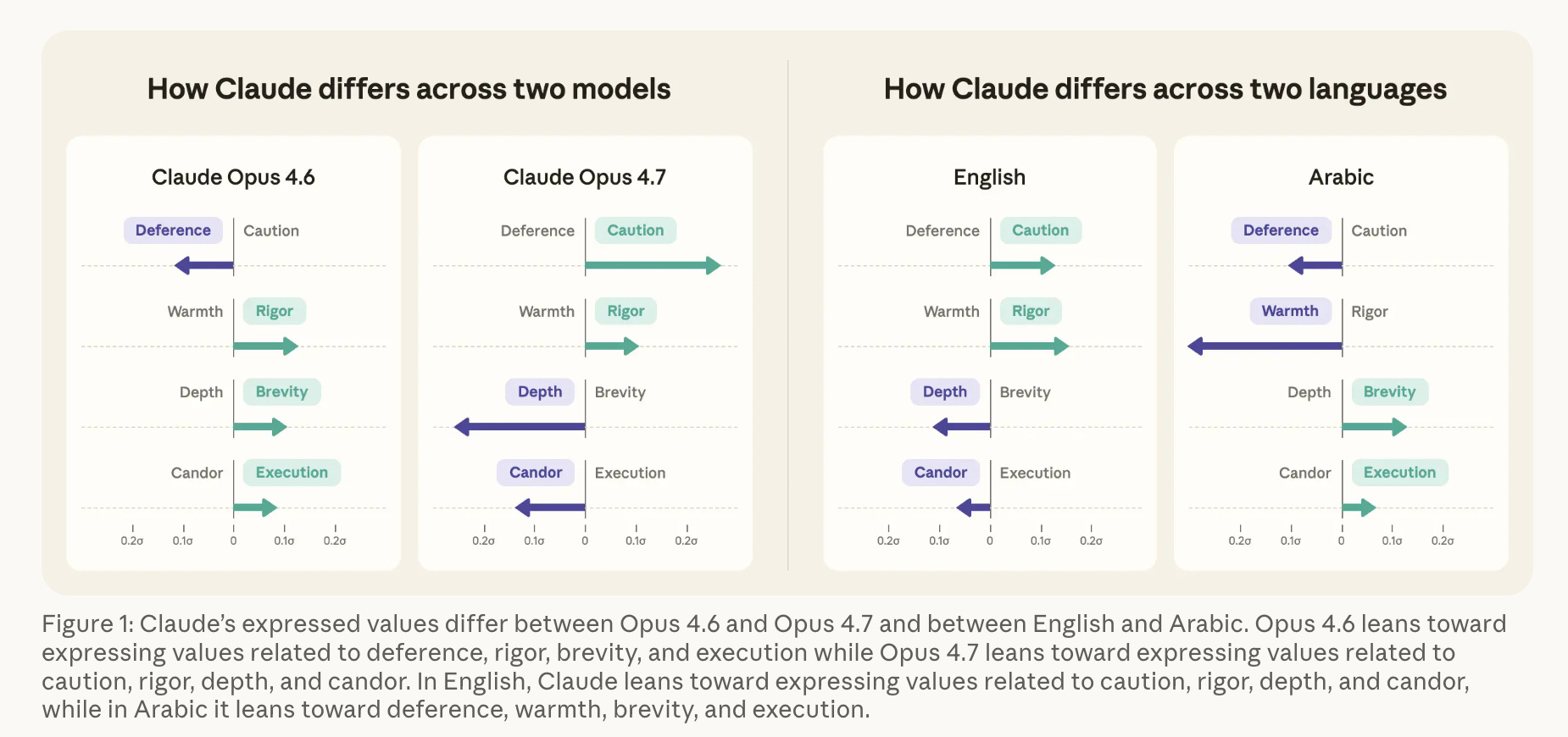
Image from Anthropic’s published research report
Their earlier Values in the Wild (April 2025) work had identified over 3,000 distinct values in Claude’s outputs.
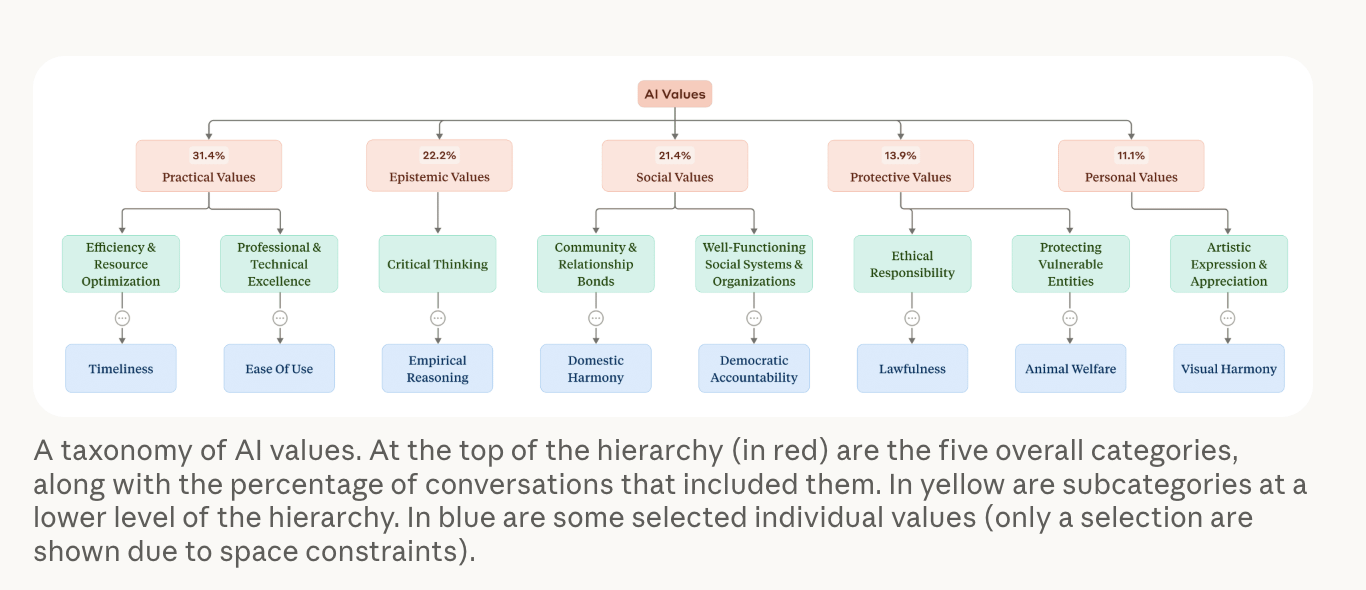
Anthropic’s AI Values from Values in the Wild Research, April 2025
A list that large is unusable for comparison, so for this 2026 research, the team clustered them into 339 high-level values, labeled each conversation for which values were present, and then applied dimensionality reduction to find the axes along which value expression varies most. Four axes emerged, together capturing 15% of the variation:
Deference vs. Caution: accommodating what the person wants vs. guarding against risk and harm
Warmth vs. Rigor: positivity and care vs. accuracy and precision
Depth vs. Brevity: explaining in depth vs. doing only what was asked
Candor vs. Execution: foregrounding uncertainty vs. producing a polished, confident answer
Importantly, they controlled for each conversation’s task, topic, and user-expressed values. So the differences they found reflect how Claude responds, and cannot be explained away by people in different languages simply asking different things.
The specific language findings: Claude expresses the most warmth in Hindi and Arabic (polite language, humor, affirmation of the person’s ideas), and the most rigor in English and Russian (challenging assumptions, correcting details, asking for evidence). It is most deferential and brief in Arabic, most cautious and deep in English, most candid about its own limitations in Dutch, and most execution-oriented in Indonesian.
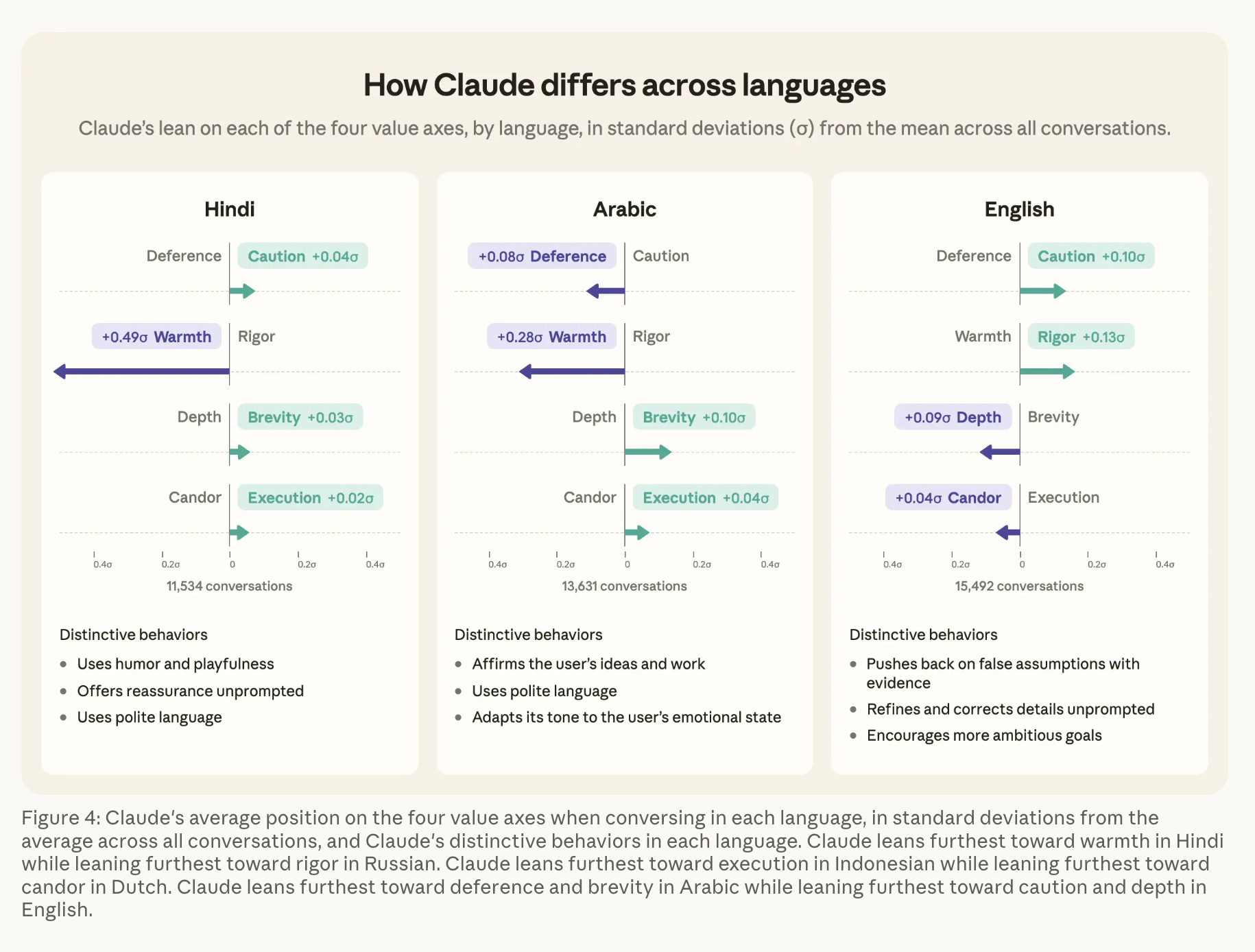
Image from Anthropic’s published research report
The researchers offer a hypothesis for why, and it is the one you would expect: training data is unevenly distributed across languages, both in quantity and composition. Their words: these “imbalances in quantity and composition could lead Claude to express different values in different languages.” And their honest admission, which Gizmodo’s coverage clearly zeroed in on: they “aren’t yet sure how much of this variation is desirable.”
My observations, from the seat of someone shipping multilingual AI
For anyone who is new: I am a product manager at a large tech company (come say hi on LinkedIn!), currently building and shipping multilingual AI products, a few of which work with Anthropic models, so this research is of course super interesting to me. I’m also someone who has worked for 10 years in the tech industry, exclusively focused on multilingual products and experiences, so this is of course something that I really love to see, and just generally, nerd out about.
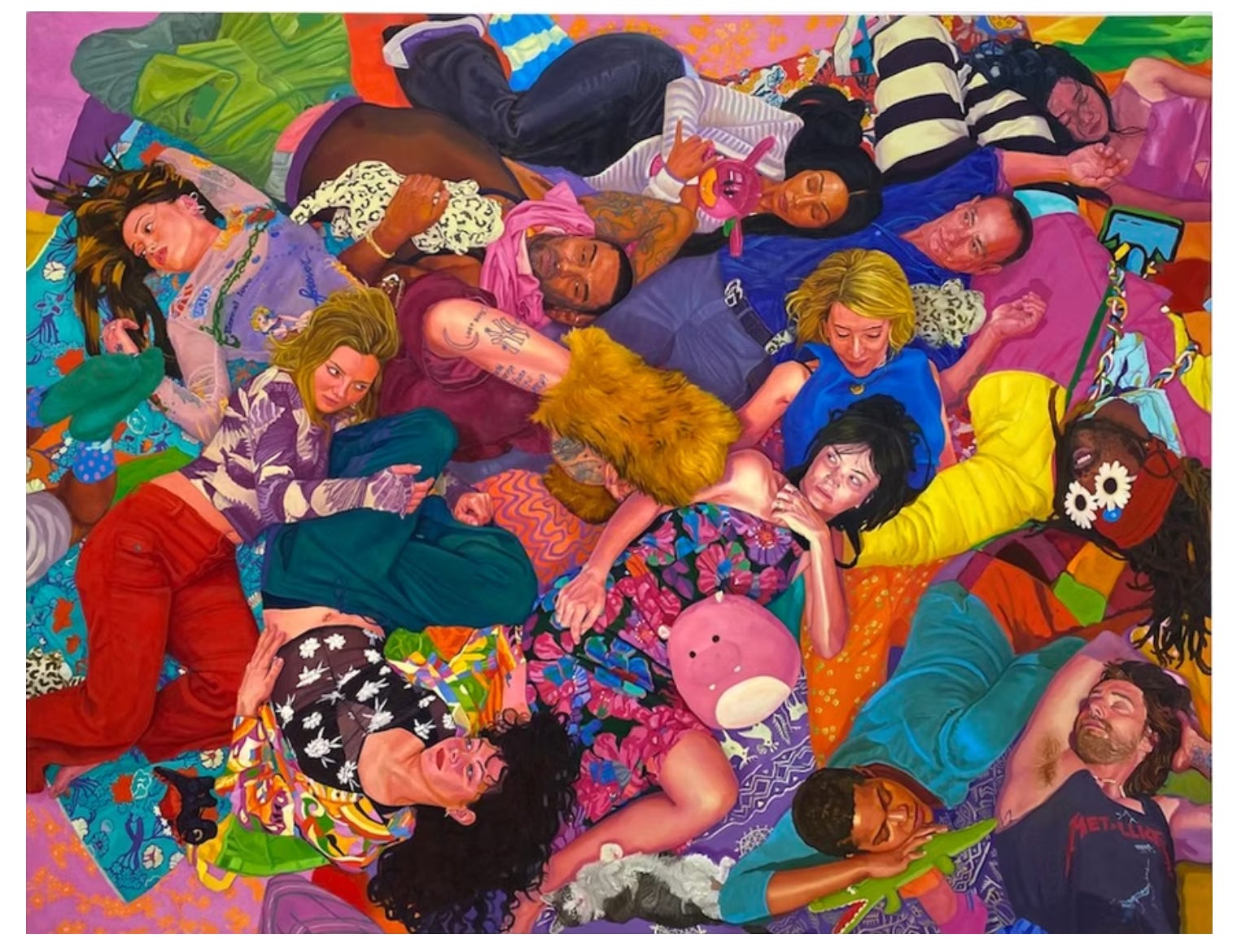
Beautiful Aliens, 2024, by Buket Savci
Ok, so first, this is what I covered in Layer 4 of my course: AI and Multilingual LLMs: What Localization Leaders Need to Know Now, this time clearly measured in the wild. In the course, I frame cultural value bias as one of six compounding layers of bias, sitting on top of training data imbalance, tokenization bias, semantic leakage, token frequency bias, and intentional poisoning. The research on cultural value bias to date has mostly come from benchmark studies and probing experiments. But this is different. This is 300k+ real conversations showing that the values a model expresses shift with language, and the lab’s own leading explanation is the foundation layer: training data imbalance. The layers compound, exactly as the framework predicts. When your training data is 70-90% English, the model does way more than just perform worse in other languages.
Here’s a section of my course (which is available to all of my paid subscribers) giving an overview of research the research on Cultural Value Bias based on published research from 2024-2026:
So second, this makes the product problem very concrete, and Anthropic even names it themselves. If two people ask for feedback on the same business plan, one in Hindi and one in Russian, the Hindi speaker would get warmth and affirmation while the Russian speaker would get pushback and demands for evidence. They walk away with different impressions of the same plan’s quality. Now extend that to whatever you are building: a support assistant, a content feedback tool, a coaching feature, a recommendation surface. If your product runs on an LLM in 30 markets, you could be shipping 30 subtly different products, and your English-language QA will not see this. Of course, THIS IS NOT NECESSARILY A BAD THING. Becauase the way we think, our cultural values, what we value as humans….is is different in different cultures. But people building products need to understand those differences reflected in LLM outputs, and make sure it’s measurable and actually accurate…there are a few things to deeply consider here, but I will wait to call those out in my 4th point below.
Third, this validates evaluation as the control point. This is exciting for me, and should be for anyone who works in language/localization. Anthropic’s proposed next step is to build value profiling into model evaluation and post-deployment monitoring: run the profile before a model ships, run it after release, flag unexpected shifts. That is evaluation harness design!!! I wrote recently about how the dominant evaluation harnesses in tech measure the wrong things for language (BLEU, COMET, and perplexity tell you nothing about whether a model is applying the wrong values in Japanese), and here is a frontier lab building exactly the kind of behavioral, per-language evaluation infrastructure I have been arguing our industry should lead! MQM already gives us categories that could be expanded to catch value misalignment (Audience Appropriateness and Locale Conventions are sitting right there). The ML community is constructing this machinery from scratch. We should be in the room, because we have been evaluating cross-cultural appropriateness at scale for decades. There is immense opportunity here, and if you lead a localization team you should be taking this research to your ML + product teams THIS MONTH to talk about how you can help them build evaluation harnesses for AI generated and translated content. Go do it, seriously! And if you want to know how, last month I wrote about how to do this.
Fourth, the open question is a governance question, and again, it is ours to answer. Anthropic asks directly: how should Claude’s values vary across languages? Some variation may be desirable. Deference in Arabic and warmth in Hindi may partially reflect genuine conversational norms, AND flattening every language into English-calibrated rigor would be its own form of bias (arguably a worse one, and we already see this happening in the majority of multilingual AI content). But, and this is where I really want to highlight something: some of it is almost certainly an artifact of what happened to be scraped for training. And what is scraped in training data is not always a reflection of the actual cultural norms in a language. (I highly recommend reading MIT Technology Review’s article, “How AI and Wikipedia Have Sent Vulnerable Languages into a Doom Spiral,” Sep. 2025) Distinguishing if it’s truly reflecting cutural norms or not requires people who can tell the difference between a cultural norm and a data artifact, per language, per market. That is a core localization competency. As I argued in The Ethics of Access, decisions like this should be co-designed and signed off by people who live in the markets these models affect, and should not be settled solely in San Francisco or Dublin or London. Anthropic acknowledges as much when they write that answering the question “would mean understanding and weighing the perspectives of the people who speak them.”
My biggest takeaway
For years, the evidence for value variation across languages lived in academic benchmarks that were easy for tech leads, engineers and product stakeholders to wave off. But now one of the top AI labs has measured it on its own production traffic and published the results. If you work in localization or multilingual product, this paper is your foot in the door. Bring it to your ML and product teams and ask three questions: Do we know how our model’s behavior varies across our markets? Do our evaluation harnesses measure it? And who, exactly, is deciding how it should vary? (I spell out how to do this based on my experience right now here)
These decisions are being made right now, in training data pipelines and eval design meetings, whether or not anyone with language expertise is present! Let’s make sure we are in the room, and claim our seat as the people who should be leading these conversations!
Want to read more? Make sure to subscribe, and/or keep the ball rolling with these recent articles:
57% vs 6%: The Multilingual Agent Gap That Should Alarm Every Localization Professional

There is a developing area in AI where I genuinely believe localization leaders can step in and take the lead right now, and I mean right now, not in two years when everyone else has figured it out too. In this article I’m going to describe:
LLM Evals and Agent Harnesses: The AI Systems Being Built Without Us (And How to Change That)

This piece grew directly out of the responses I got to my recent article, 57% vs 6%: The Multilingual Agent Gap That Should Alarm Every Localization Professional. So many of you told me that the concept of agents, what they are, how they work, and where they fail multilingually, was genuinely new territory. BUT, that piece was focused on one
Perfectionism Is a Localization Problem: Your Best Skill Has a Blind Spot

Note: In today’s piece I featured art that made me think about moving super fast!
Aaaah this is the kind of post I’m always so excited to read. Thank you for doing all the work 🥰